
Table of Contents
Introduction
Make money with affiliate marketing without a website — is it really possible for beginners?
The short answer is yes.
In fact, many people earn their first affiliate commissions through YouTube, email marketing, social media, and online communities before they ever launch a website.
If you’ve been researching affiliate marketing for even a few days, you’ve probably noticed something.
Almost every guide tells you to start a website.
Buy hosting.
Install WordPress.
Write blog posts.
Learn SEO.
Wait for traffic.
And while that’s good advice for the long term, it’s not always realistic for beginners.
Maybe you don’t have a website yet.
Maybe you’re not ready to spend money.
Or maybe you simply want to understand whether affiliate marketing actually works before building a blog.
The good news?
You can absolutely start affiliate marketing without a website.
In fact, many people get their first affiliate clicks, leads, and even commissions before they ever launch a website.
The key isn’t having a website.
The key is getting attention and building trust.
That’s what makes people click your links.
And that’s what ultimately leads to commissions.
Why People Want to Make Money With Affiliate Marketing Without a Website
Many beginners want to make money with affiliate marketing without a website because it allows them to start quickly without investing in hosting or web design.
I think a lot of this comes from older affiliate marketing advice.
Years ago, the typical path looked like this:
- Build a website
- Write content
- Rank on Google
- Add affiliate links
- Earn commissions
That model still works today.
Actually, it’s one of the reasons I started building my own website.
But it’s not the only way.
Today people spend hours on:
- YouTube
- TikTok
- Telegram
- Email newsletters
- Facebook Groups
Attention has moved beyond websites.
And wherever attention exists, affiliate marketing opportunities exist too.
How Affiliate Marketing Works Without a Website
The process doesn’t really change.
You still:
- Join an affiliate program
- Get your affiliate link
- Share useful content
- Help people solve a problem
- Earn a commission when someone takes action
The only difference is where you’re sharing that content.
Instead of relying on a blog, you’re using platforms that already have an audience.
That’s why beginners often start there first.
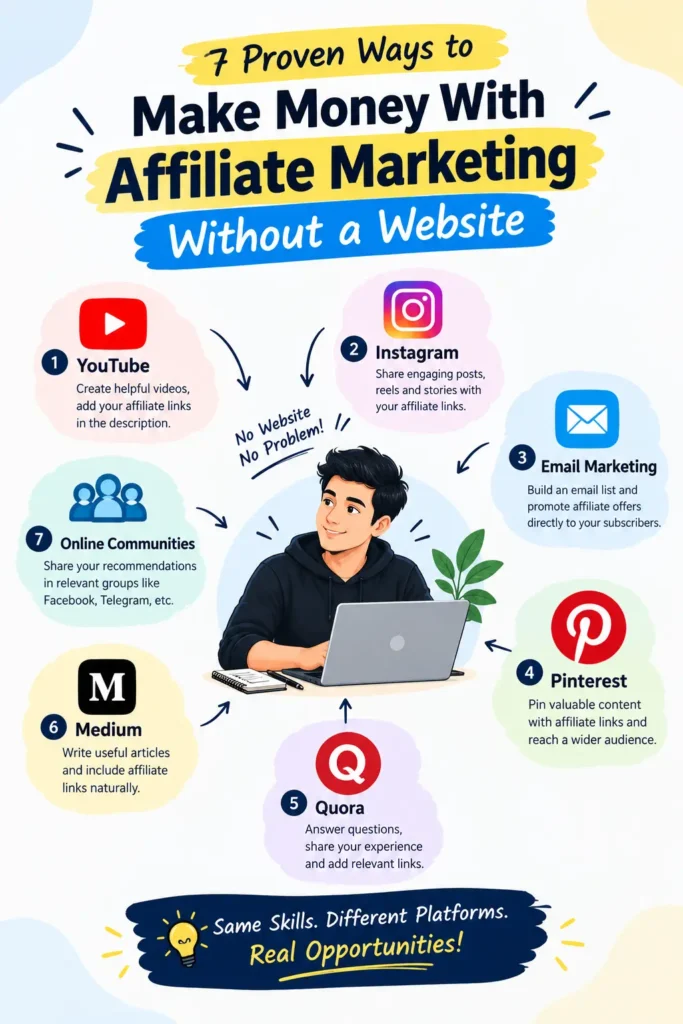
1. Use YouTube to Build Trust
If I had to start from zero today without a website, YouTube would probably be my first choice.
Why?
Because people search YouTube when they’re already interested in something.
Think about the last time you bought software.
You probably watched a review first.
Maybe a tutorial.
Maybe a comparison video.
That’s exactly where affiliate marketing fits naturally.
You can create:
- Reviews
- Tutorials
- Comparisons
- Case studies
- Beginner guides
Then place affiliate links in your description.
One helpful video can continue bringing clicks for months.
Sometimes years.
2. Grow an Instagram Page Around One Topic
A mistake many beginners make is posting random content.
One day motivation.
Next day memes.
Then affiliate links.
That usually doesn’t work.
People follow accounts because they know what to expect.
Pick one topic.
For example:
- Affiliate Marketing
- Blogging
- AI Tools
- Freelancing
- SEO
When your content stays focused, trust builds faster.
And trust leads to clicks.
3. Build an Email List Early
This is probably the method most beginners ignore.
But experienced marketers love email.
The reason is simple.
You own your email list.
You don’t own Instagram.
You don’t own YouTube.
You don’t own TikTok.
Algorithms change all the time.
Your email list doesn’t.
Even a few hundred subscribers can generate affiliate commissions when you consistently send useful content.
4. Answer Questions People Are Already Asking
One thing I’ve noticed is that beginners often try to create demand.
A better approach is finding existing demand.
That’s where platforms like Quora help.
People literally tell you what they want to know.
Questions like:
- Is affiliate marketing worth it?
- What’s the best hosting provider?
- Which email tool should I choose?
When you provide a genuinely useful answer, some readers naturally want to learn more.
That’s where affiliate recommendations fit.
Not as spam.
As a solution.
5. Publish on Medium
Medium gives new writers something most new websites don’t have.
Authority.
Google already trusts Medium.
That means articles can sometimes get visibility faster than a brand-new blog.
You can publish:
- Tutorials
- Personal experiences
- Reviews
- Industry insights
It’s not a replacement for owning a website.
But it’s a great starting point.
6. Use Pinterest Like a Search Engine
A lot of people think Pinterest is only for recipes or DIY projects.
That’s outdated thinking.
Pinterest works surprisingly well in niches like:
- Online business
- Blogging
- Productivity
- Marketing
- Freelancing
The biggest advantage?
Pins can keep generating traffic long after they’re published.
Unlike social posts that disappear within hours.
7. Build a Community Instead of an Audience
There’s a difference.
An audience watches.
A community interacts.
And communities often convert better.
That could be:
- A Facebook Group
- A Telegram Channel
- A Discord Server
The goal isn’t posting affiliate links every day.
The goal is helping people.
When trust grows, recommendations feel natural.
That’s when affiliate marketing becomes much easier.
Mistakes That Stop Beginners From Earning
Promoting Everything
This is probably the fastest way to lose trust.
If every post recommends a different product, people stop paying attention.
Stay focused.
Thinking Affiliate Marketing Is About Links
It’s not.
Links don’t make money.
Trust does.
The link is just the final step.
Ignoring Content Quality
One useful piece of content can outperform dozens of low-quality posts.
Focus on helping people first.
Sales usually follow.
Expecting Results Next Week
Affiliate marketing rewards consistency.
Not impatience.
Most people quit before their content has a chance to work.
Should You Build a Website Later?
Personally, yes.
Even if you start without one.
A website gives you:
- Search traffic
- Brand authority
- More control
- Better monetization options
That’s why many successful affiliates start on social platforms and eventually build a website.
Final Thoughts
If your goal is to make money with affiliate marketing without a website, focus on helping people rather than chasing quick commissions.
Can you make money with affiliate without a website?
Yes.
Thousands of people already do.
But here’s something worth remembering.
The people who succeed usually aren’t obsessed with finding shortcuts.
They’re focused on helping people.
Whether that’s through YouTube, Instagram, email marketing, communities, or written content.
Start with one platform.
Learn it properly.
Stay consistent.
And don’t worry about doing everything at once.
Your first affiliate commission usually comes from focused effort, not from trying twenty different strategies at the same time.
Want to Learn Affiliate Marketing Step by Step?
If you’re serious about building an affiliate marketing business and want guidance instead of spending months figuring everything out alone, you can learn directly from me.
Inside my mentorship and online classes, I share practical strategies for:
✅ Affiliate Marketing
✅ Content Creation
✅ SEO Basics
✅ Website Building
✅ Traffic Generation
✅ Earning Your First Affiliate Commission
If you’d like to learn personally and get support on your journey, feel free to reach out.
I’d be happy to help.
Related Posts
📖 What Is Affiliate Marketing?
📖 Affiliate Marketing Without a Website